




Hjem | 3 steps to take advantage of the potential in your marketing data

Have your existing data analysed in Dynamics 365 (both sales and marketing data). Find out what you’re using and at what level.
The result of such a data analysis should give you insight into whether you’re fully leveraging your existing data. That insight should translate into direct actions — things you need to change, stop, or do more of.
In short, you should increase your business value through data and analytics.
A data analysis can identify trends that aren’t visible when looking at a single data point. The combination of multiple points can provide a more accurate picture of what’s working — and what’s not.
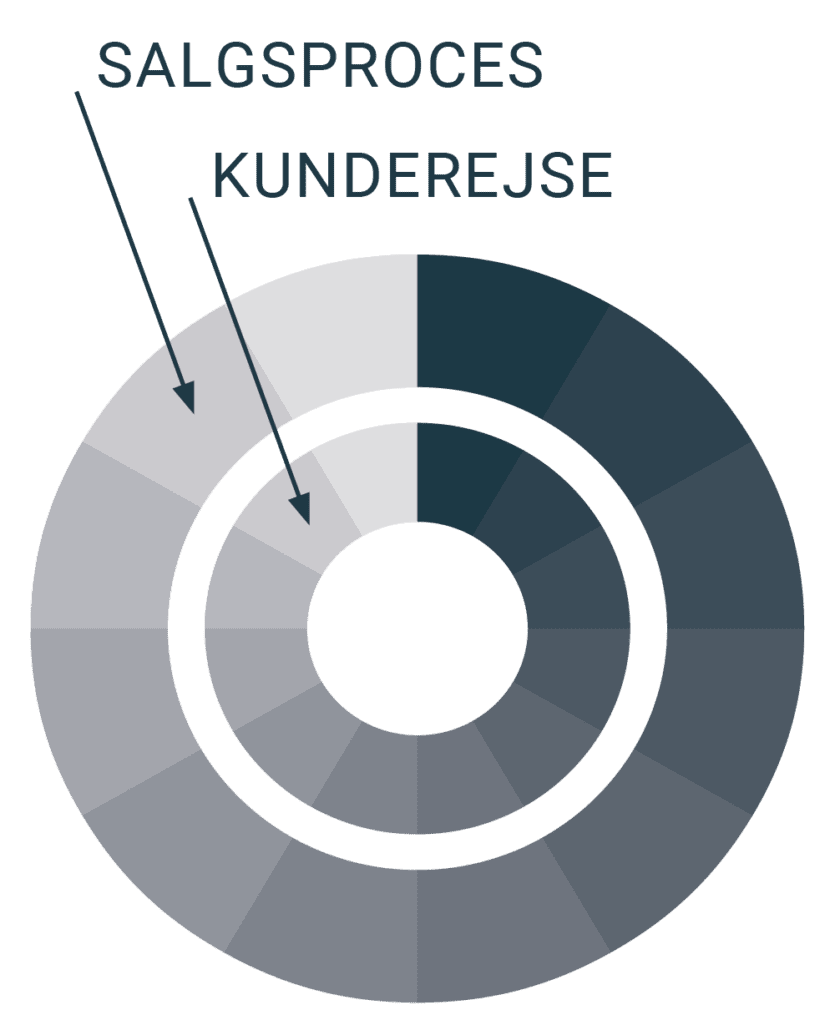
Going forward, it will be even more important for the sales process to align with the customer journey.
A data analysis should be able to show where leads are located within the customer journey, so that sales and marketing activities are targeted and coordinated.
One example could be that a particular source drives a lot of visitors to your website. It might seem obvious to invest more in driving traffic from that same source.
But deeper insights can reveal more. Maybe there’s high traffic from one source, but the conversion rate is lower compared to another source that drives fewer visitors. Or maybe the Life Time Value (LTV) is lower, the Cost-per-Lead (CPL) is higher, or the visitors are at the top of the funnel and not as qualified as you thought — meaning your sales approach might need to change.
These might sound like buzzwords, but if you don’t have access to this kind of data, you’re relying on gut feeling rather than facts. The companies that stay in control of this insight are the ones that perform best.
If you don’t know how to analyse your data — or lack the internal skills in your organisation — you should reach out and make use of external resources.
You need to make an active decision about whether you want to make better use of your data. If the answer is yes, then get someone who can help you do just that.
Learn from your existing data as a starting point and gain insights into how you can work smarter and more efficiently in the future.
Going forward, how can these new insights be repeated and actively used?
If you’ve analysed your existing data and gained new knowledge, a natural next question is: how do we gain the same insight in our future work, and how can we be proactive?
You need to ensure that data analysis is accurate and ongoing. Insights should be easily accessible, which means data needs to be visualised — for example, in a dashboard. Microsoft Power BI has standard integration with Dynamics 365, making it easy to create simple views that help ensure continuous insight into your data.
To the right, you can see an example of a dashboard displaying a marketing funnel. It could just as well be a sales funnel or something similar. The point is to make data visible using selected KPIs, so the sales team can quickly gain insight and get an overview.
(We offer several standard dashboards tailored for data from Dynamics 365 – plug-and-play solutions. Contact us to learn more about the possibilities.)
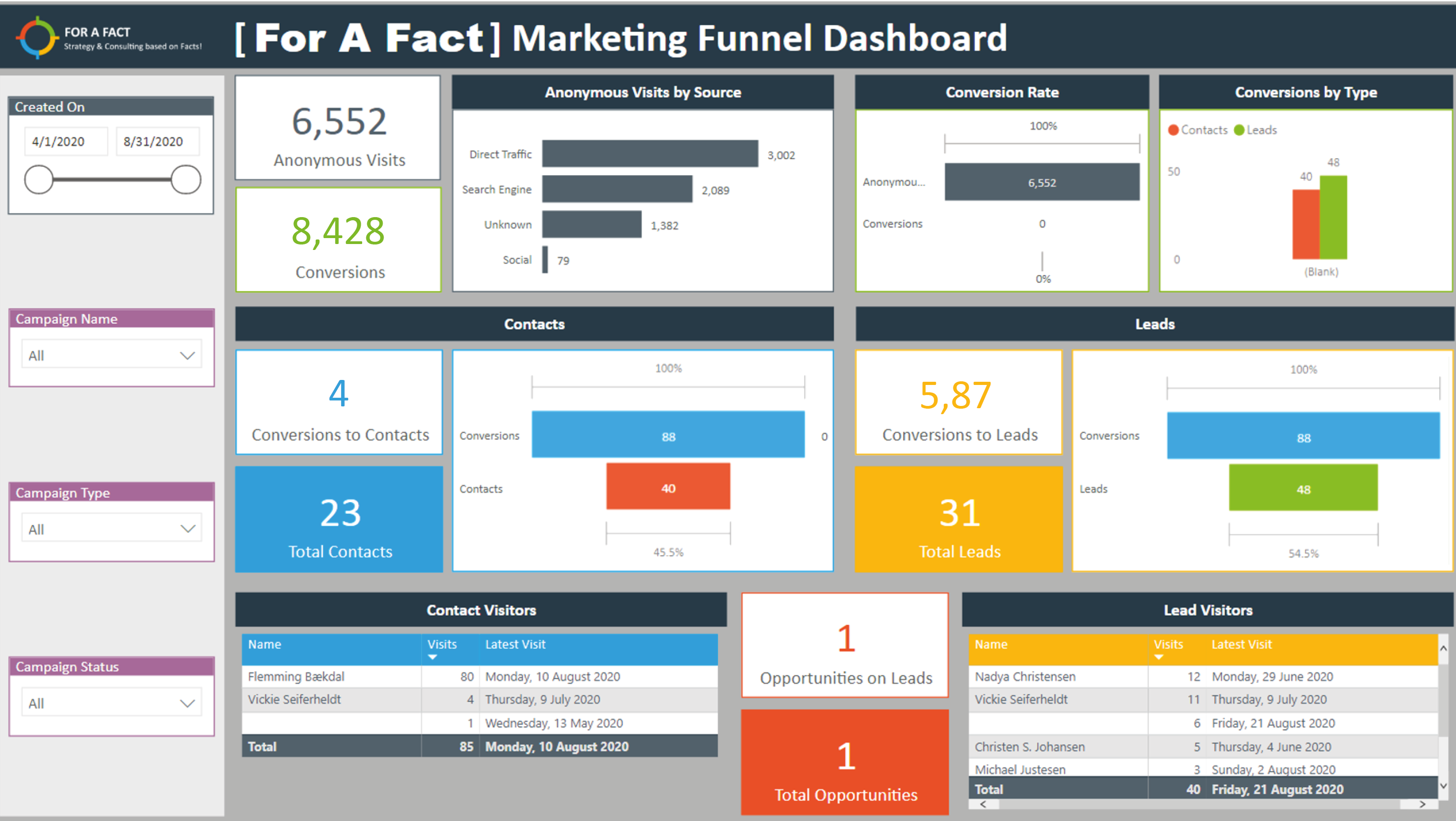
Start simple and visualise the data you work with daily — make sure the visualisation gives you a clear overview you don’t currently have.
Next, work on automating as many elements as possible.
Data should be easy to access. If collecting and analysing it takes too long, the reality is you won’t find time for it in a busy workday.
If sales is to understand where a lead is in your sales funnel, or how qualified it is based on the data you have about that person, it must be easy and straightforward to see.
If it’s a marketing campaign being activated, you need continuous insight — not just an analysis after the campaign ends.
The goal of data visualisation is to stay ahead and act proactively. If data analysis doesn’t happen continuously, you’ll quickly end up where you are now — with loads of data and no real insights to act on.
Plan how to ensure that doesn’t happen and decide what insights should be available on an ongoing basis, so you have the best conditions for success.
With the new insight from your data and analysis, which has given you new knowledge, you should be able to set concrete goals for your ongoing work.
You’ll find that your processes and activities need to be continuously adjusted. As you gain further insight, you’ll be able to see what works and what doesn’t. The difference is that now, you can quickly do more of what works — and change or stop what doesn’t.
Our recommendation would be to create a decision-making document.
Choose a few areas where you want to make an effort, or where you believe you can quickly get started.
Describe how you want to work going forward, and how data should support your decision-making process. Then make sure you have the necessary data available — or plan how to get it. Set goals and plan how to achieve them, but also how you’ll analyse the data so you can act on the insights you gain.
We recommend creating a decision-making document that outlines all these elements.
Finally, gather everything into a project folder, document the various processes, and break them down into individual tasks.
These were just 3 different actions you should take, but we could easily have described many more possibilities.
Whether these 3 initiatives are the right ones for your business to start with — or whether you should begin elsewhere — depends on where you currently stand in terms of leveraging the potential of your data and getting more value from your investment. Maybe you’re in a different place and need to start differently?
You’re welcome to contact us for a non-binding conversation about your options. We have over 10 years of experience advising on data in Microsoft CRM and Dynamics 365.
After reading the 3 steps, consider whether you’re already making the most of your data — and if not, why?
As long as you keep doing what you “normally” do and don’t start making data-driven decisions, you won’t unlock the full potential of your data — and you won’t get the maximum return on your investment in your marketing system. It requires the right skills to achieve a return, and unfortunately, this area often lacks focus in many companies.
